Thursday, June 4, 2015

FOUQUET'S QUEEN OF HEAVEN

JEAN FOUQUET (French, Tours circa 1420-1481)
MADONNA AND CHILD SURROUNDED BY SERAPHIM AND CHERUBIM
Painted around1452
Oil on panel
94,5 x 85,5 cm
Antwerp, Royal Museum of Fine Arts

THE QUEEN OF HEAVEN
When you play kings and queens do you wear a crown, a robe and sit on a throne giving orders?
Would you shave your hairline to give the impression that you have a very high forehead? 
Name the jewels in the crown!
Are the tassels of the throne made of real gold thread? Ermines have little dark tails and make up the fur lining of the white silk coronation robe. How does Fouquet manage to make the gauze veil look so transparent?
Does the Virgin look like a real person or did Fouquet invent that perfectly beautiful face?  She was real and her name was Agnes Sorel.   They say Agnes was the most beautiful woman in the world and she was a close friend of the King.
THE BABY
Jesus seems to be floating on the folds of the cape.  Instead of drinking milk, he is showing us something to the left. 
THE DIPTYCH
The Madonna makes up the right half of a Diptych.  A diptych (from the Greek word for the number two) is an altar that is small enough for travel. It is made of two same size panels that are hinged together and that can be folded and shut. The left half represents Saint Steven with Etienne Chevalier, the Treasurer of the King. He had commissioned Fouquet to paint the diptych.  The diptych was taken apart in the 18th century.  (The other half is in the Gemäldegalerie Berlin, look for “the Melun Diptych” on the Internet!)
THE ANGELS
Cherubim guard the heavenly throne. We don’t see the bodies of the blue cherubs; only one little foot is peeking out on the right edge.  In medieval times blue was the symbol of heaven.
Seraphim (Hebrew: “the burning ones”) carry the throne.  They normally have six wings, two to fly and two to cover their eyes.  Spot an extra wing on the seraphim who is looking demandingly at us. Fouquet paints these angels in “burning” red, the color of love! 
ART DETECTIVES
Can you spot the reflection of Fouquet’s studio window on the two balls of the throne?
Does the skin tone of the mother and child resemble white marble or real skin?
What are the three main colors in the picture?
Hint: the king’s coat of arms was made of red, white and blue!
FOUQUET
Fouquet worked for Charles VII and also illustrated beautiful books.  Joan of Arc had put Charles on the throne at the end of a war that lasted one hundred years.  Charles had a wife but his true love was Agnes.
Agnes had already died by the time Fouquet painted her, but her beauty was unforgettable. 

Fouquet had traveled to Italy to see great art.  He also admired Jan van Eyck (see previous blog)who was a bit older.  His style of painting represents the transition between the late Gothic and Early Renaissance.

Wednesday, May 13, 2015

HOMER: INDEPENDENCE DAY

WINSLOW HOMER (American, 1836-1910)
DRESSING FOR THE CARNIVAL, 1877
Signed lower right: WINSLOW HOMER N.A./1877
Oil on canvas
50,8 x 76,2 cm
New York, The Metropolitan Museum of Art
INDEPENDENCE DAY
It’s a gorgeous Independence Day, time to get ready for the parade!   On this 4th of July, 1877 temperatures in Virginia may climb to the 90’s.  What time of the day is it? People are getting ready early in the morning while it’s still cool.
COSTUME
Will you make your own costume or does someone have to sew you into your outfit?  Would you like dress as a Harlequin?  What is a Harlequin anyway; a sort of clown?  What are the colors of the Harlequin’s costume? 
His costume is usually made of red, blue and yellow patches. The Harlequin is the funny character from the 16th century Italian Commedia del’ Arte, (Comedy of Art), a vagabond troupe that traveled from village to village to entertain people with funny stories.  If you want to be the Harlequin your role will be to play tricks on people, especially your master.  
PARADE
One kid is prepared for the heat and is carrying a straw fan.  Did the kids buy that fan or make it themselves?  
The dazzling light is throwing patches of highlights on the group.  What does the Harlequin have in his mouth?  Will the woman who is smoking the pipe catch the butterfly?  The woman on the left is sewing a button on the Harlequin’s costume.  What is the little girl on the left holding?  Do you think she is standing by herself because she wants to be the first to go to the party?  
The kids are not wearing shoes, even though there may be snakes in the grass.  Are their clothes new or are they also made of patches and rags?
In 1877 African Americans have only been free from slavery for twelve years and they are very poor.  
HOLIDAY
For the Carnival, people dress up in costumes and party. 
Junkanoo was a festival that was celebrated during times of slavery.
The 4th of July is the day Americans celebrate Independence from Great Britain.   
How many flags can you spot?
Do you think this picture is a mix of all three celebrations?  Will everyone have a great time?
IN THE OPEN AIR
En plein air is French for “in the open air”.  Do you think Homer painted this picture en plein air with his easel propped up in the fenced-in garden?   
HOMER
During the Civil War Homer worked for a magazine as an illustrator.  With the help of Homer’s pictures people could find out what was going on in the war from the magazine.  After the war ended and slavery was abolished Homer returned to Virginia to see how people lived.  He originally called this picture:  Sketch-4th of July in Virginia.
Homer had been to Paris in 1867.  He wanted to develop his own way of painting but might have seen the work of Édouard Manet (p..) and other French artists.
Many think that Homer is the greatest American artist of the Nineteenth Century.  In addition to oil paintings he made some stunningly beautiful watercolors.  


Thursday, March 19, 2015

GIRODET: FREEDOM


ANNE-LOUIS GIRODET-TRIOSON (French, 1767-1824)
JEAN-BAPTISTE BELLEY
Signed and dated lower left:  A L Girodet f.cit an V.
Oil on canvas
159,5x 112,8 cm
An is French for year and the Roman numeral V stands for the 5th year in the French revolutionary calendar. It is the year 1796 in our Gregorian calendar.
Château de Versailles
MONSIEUR BELLEY
Do you think Monsieur Belley has had a hard life or an easy life?
Is he young or middle-aged?
Is he proud or modest, foolish or wise? 
Can he be easily bullied?
Has he done manual labor? Look at the veins in his hands and the marble of the pedestal!
Is he done fighting or must he continue?
IMAGINE
Imagine being born about 270 years ago in Senegal, West Africa.  You are two years old when you are being sold as a slave to Saint-Domingue, present day Haiti.  You arrive in the French colony in the Caribbean, far away from Senegal.  You are one of 500,000 slaves who speak many different African languages. You cannot always understand each other.
Dawn to dusk you toil away in the sweltering heat.  You harvest coffee and sugar cane.  This puts coffee and sweets on the dining tables of Europe.
LIBERTY
You save up your earnings to buy your freedom.   
You become an infantry officer and fight in a revolution on the island.  You then travel to Paris and represent Saint-Domingue in France.  Do you think people always treated you with respect?  
You are the elected deputy from Saint-Domingue.   Your name is Jean-Baptiste Belley and you are at long last a free citizen of France.
EQUALITY
Belley is leaning on a pedestal with a white marble bust. Raynal had written in favor of the abolition of slavery.  Even though Raynal’s head is much bigger than Belley’s, they are on the same level. Are they equals?
FRATERNITY
The Revolutionary Wars are raging in Europe. A young artist Anne-Louis Girodet (he is a man, despite his first name) has been asked to paint the achievements of the Revolution. Does Girodet paint Belley in his studio or on top of the hill?  Does the landscape look French or Caribbean?  Spot some smoke coming from a burning building!  This may remind us of the revolution Belley fought on the island.
We are looking up at Belley who is gazing at the sky.  Do you feel like tapping his muscly arm so he turns around and looks at you?  Why is he wearing a shiny gold earring?   In Roman times a freed slave who advanced to the rank of knight was allowed to wear a gold ring and run for public office. 
The tricolored silk sash is tied around the waist of his uniform. The uniform shows that you represent the people.  This is the first painting of an African-born man as a powerful western ruler.  Do you know the three colors of the French flag?
 “Liberty-Equality-Fraternity” is the motto of Haiti and of France!
NAPOLEON
In 1802 Napoleon reinstates slavery. Together with Napoleon’s brother-in-law, Belley returns to Saint-Domingue in 1802.  There he is arrested and brought back to France where dies in prison three years later. In 1848 France once again abolishes slavery, a crime against humanity. 

Tuesday, March 3, 2015

GUSTAV KLIMT'S JEWEL


GUSTAV KLIMT (Austrian, 1862-1918)
ADELE BLOCH-BAUER
Signed and dated lower right: GUSTAV KLIMT 1907
Oil, silver and gold on canvas
140 x 140 cm
Neue Galerie, New York

BE DAZZLED
Enter the shimmering aura of Adele Bloch-Bauer.
Would you like to be painted like a modern Byzantine icon, encrusted in gold? 
Would your face appear transparent, your hands delicate and your eyes made to look like two large almonds?
Can you name some of the precious stones and metals in the picture?
Even the green floor on the left seems to be made of pure emerald.
Is Adele sitting in a chair or standing?
Find the contours of the big wing chair.
Symbols and patterns make up the background, chair and dress.
Klimt admired Egyptian art where eyes are the symbol of protection from evil.
Can you count the eyes on her dress?
Behind her chair is another pair of eyes; whose eyes might they be?
On the flowing cape you will find her gold encrusted initials: A and B!
GLAMOUR
A hundred years ago Adele was one of the most glamorous women in cosmopolitan Vienna.  She persuaded her husband to hire Klimt to paint her portrait. It took Gustav Klimt three years to finish the picture.
Now Adele is the most glamorous woman in New York.  Like pure gold, her beauty never tarnished.
THE LONG ROAD TO NEW YORK
In 1938 the Nazis stole Ferdinand Bloch-Bauer’s house in Vienna, the art collection, his castle near Prague and his sugar factory.  They didn’t like the Klimts and sold them to an Austrian museum.   The portrait of Adele stayed there until recently.  The Austrian government believed the museum owned it.  This was not true.  It belonged to Adele’s niece and heir Maria Altmann, who had fled to Los Angeles, California.  68 years later with the help of an Austrian journalist and an American lawyer, 90-year old Maria won her case.  In 2006 her property was returned to her.
THE JEWEL OF NEW YORK
Maria Altmann decided to sell the picture.  Adele’s portrait is now the centerpiece of a precious jewel box of a museum, the Neue Galerie, New York.  You have to be 12 years old to visit Adele but in the meantime you can console yourself at the museum café with the best apple strudel and hot chocolate this side of the Atlantic. 
SILENCE IS GOLDEN
Klimt didn’t like to mince words.  He painted instead.  He portrayed many of the beautiful ladies in Vienna.
He made many pencil drawings to prepare for the painting.
The artist draws his design with adhesive on the canvas. He then gently brushes the gold and silver leaf on the adhesive.   The rest dusts off and the gold or silver design remains.
GOLD
Why has gold always been so important to humans?
It has to be mined.
It does not tarnish.
It is soft.  This means you can engrave it and mold it.
Gustav Klimt’s father was a gold engraver. 
How many expressions and fairy tales do you know that involve the word gold?
THE MOVIE
The story is now a movie: “Woman in Gold”.


Monday, January 19, 2015

WATTEAU'S SHOP SIGN


JEAN-ANTOINE WATTEAU (French, 1684-1721)
THE SHOP SIGN OF GERSAINT-1720
Oil on canvas
163 x 308 cm
Charlottenburg Castle, Berlin
Stiftung Preußische Schlösser und Gärten Berlin Brandenburg

THE SHOP
You are entering a shop in Paris.  The year is 1720. You can choose to be a shopper or a shop assistant.  If you are a rich man you need to wear a wig.  If you are an elegant woman you have to wear a fashionable silk dress and pin your hair up with a ribbon.

Take a step up from the cobblestone street into Monsieur Gersaint’s shop.  Don’t trip over the bundle of straw on your left.  It will be needed to pack up the pictures. 
Would you give a hand to the shop assistants who are putting King Louis XIV’s portrait into the wooden crate? (The king had died five years earlier.)  The woman wearing the pale pink silk dress is glancing at the portrait while a gallant man is helping her up the step.  Will she buy the portrait?  What is the color of her stocking?
Take a look at the pictures on the wall and see what you can identify: portraits, landscapes, nudes and stories from the Greek myths.
Where could the glass door lead to: a storage room or office? There seem to be windows on the left.
On the right a standing man is explaining the large oval picture to a couple.  Are they young or a bit older?  They are inspecting the picture with magnifying glasses.
Can you see what the woman is looking at and what fascinates the man?
The woman is taking a close look at the trees.  The man seems so fascinated by the nude’s knee, that he has to kneel on the floor!

On the far right another group of people is being shown a small picture or mirror by a young sales woman.  Do they appear riveted by what they see?  Would it not be funny if they were looking at themselves rather than a painting?
Are you tempted to pull on the woman’s shoe that is peeking out from under her striped silk dress?
What would you buy in the shop, a painting, a clock, a mirror or a box?  Or would you prefer to take home the nice sleeping dog on the right?
ART DETECTIVES
The shop seems crowded.  Do you think you fit inside? 
Is it a sunny day or is it overcast?
Where does the light come from?
The silk and white of the suits and dresses capture the light.  The rest of the picture is bathed in gentle browns and beiges.  Is there a lot of color in the picture?
FUN FACT
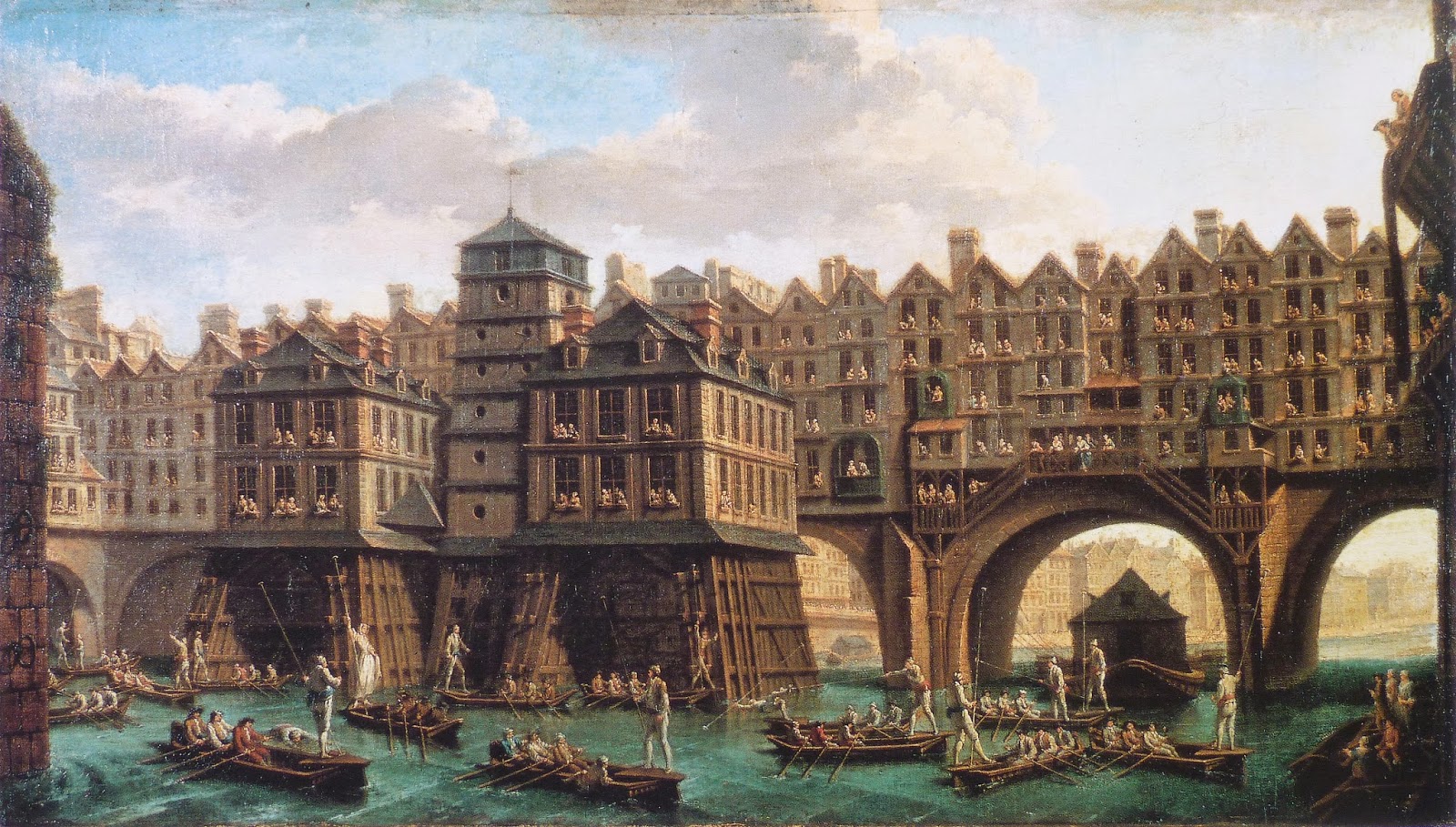
Gersaint was Watteau's dealer.  His shop was on a bridge.  See what it looked like in the 18th century.  Today there are no longer any shops on the bridges in Paris.

Nicolas-Jean-Baptiste Raguenet
La Joute de mariniers entre le pont Notre-Dame et le Pont-au-Change, c. 1752
47 x 83.5 cm
Oil on canvas
Musée Carnavalet, Paris
WATTEAU
The painting is roughly the same length as the shop: about three meters.  
The picture was displayed as a shop sign for fifteen days.  
Originally the canvas was larger and had an arched top.  
Someone cut it in half.   A different painter made it into a rectangle.
The paintings seen on the wall of the shop were not the same as in the shop.  Watteau used his imagination to invent the dealer´s inventory.
The picture was more of an advertisement for Watteau than for Gersaint.
This picture is Watteau’s last masterpiece. 
Watteau took only eight days to paint the picture.
He always thought that his drawings were better than his paintings.

Monday, December 8, 2014

ALTDORFER'S MIDDLE EARTH

Albrecht Altdorfer (German, 1480-1538)
The Battle of Issus
Signed lower left with monogram: AA and signed lower edge: ALBRECHT ALTDORFER ZU REGENSPURG FECIT
Oil tempera on lime wood panel
158 x 120 cm
Painted in1529
Alte Pinakothek, Munich

FANTASY MOVIE 
or PAINTING?                              
Does this picture remind you of a fantasy movie?
It seems hard to believe that it was painted almost 500 years ago.
ART DETECTIVES
Find the Persian King Darius in his chariot of three white horses and Alexander the Great, in hot pursuit. 
THE BATTLE
The year is 333 BCE; the place is present day Turkey. 
Listen to the ear splitting noises of battle cries and thousands of horses charging.
Alexander’s cavalry and infantrymen are in full body armor and plumed helmets.
The Persian king Darius’ troops wear red uniforms and exotic turbans.  They don’t use saddles and are riding their horses bareback.
The weapons are bow and arrow, spears and lances.
There are women in this picture. They look like fancy German ladies going to a party wearing feathers on their hats.  They are riding their horses sidesaddle.  Can you find them?
Altdorfer invented this; there were no female soldiers at Issus.
Identify the different expressions on the faces of the knights!  Some seem terrified, anxious, confident or calm.
Whose armies are larger, Alexander or Darius?
Alexander’s troops are lined up in perfect formation.
Darius’ men are being pushed into darkness.   The sun is shining upon Alexander’s soldiers.
You will now be able to tell who won.
AFTER THE BATTLE
Ride up to the tents of the bivouac at the outskirts of the city! You may find refreshments there.
Then move up the ramparts, past the fortress and climb the tower of the castle.  From there you’ll get a good view of Alexander’s future empire:
The island of Cyprus lies in the center of the Mediterranean Sea.  Look beyond for Egypt’s River Nile pouring into the sea.   
Hint: The Delta of the Nile has seven arms.
The Sinai Peninsula connects Africa with Southwest Asia.
The Tower of Babel in the shadow on the left is looking rather small!
Altdorfer’s earth ends with the Red Sea.  At the horizon you will even see the curvature of the globe.
ALTDORFER’S WORLD
Does Altdorfer get the events and the geography right?
No, he takes many “artistic liberties”. 
Accuracy is not his point.  He wants to convey to us the magnitude of the event. 
With the victory at Issus Alexander’s empire became the largest of the ancient world. It encompassed Persia, Egypt, Greece and Babylon.
SYMBOLS
The sun symbolizes the West (Alexander) and the sickle moon stands for the Near East (Darius).
THE SKY
The dramatic sky takes up almost a third of the picture.
The clouds burst open to make space for a tablet that describes the scene:
Alexander the Great defeating the last Darius, after 100,000 infantry and more than 10,000 cavalrymen had been killed amongst the ranks of the Persians. Whilst King Darius was able to flee with no more than 1,000 horsemen, his mother, wife, and children were taken prisoner.
This tablet is so much prettier than your average museum label!  It looks as though you can move it around by pulling on the cord.
FUN FACTS
The battle took place 800 years before Altdorfer painted it.
Alexander was only 23 years old when he won at Issus. 
He always rode alongside his men in the front ranks.
He never lost a battle.
Napoleon I was a great admirer of Alexander the Great. 
Napoleon’s armies invaded Bavaria and they took the painting to the Louvre in Paris. After Napoleon crowned himself Emperor, he removed it from the museum and supposedly hung it in his bathroom.
The painting was then returned to Munich where you can see it today.
FOR FANS OF THE HOBBIT and 
THE LORD OF THE RINGS
Both Tolkien (the author) and Jackson (the movie director) MUST have seen this painting!
If you let your imagination wander, you will see areas in the painting that will remind you of:
Mirkwood
The Tower of Orthanc
The Eye of Sauron
Anduin Sea
The City of Dale with Laketown
The Lonely Mountain and Misty Mountain
Helm’s Deep Fortress
White City
Dol Guldur
ALTDORFER
He was a Northern Renaissance painter and one the founders of Western Landscape Art.